






Industry work led by classification societies and the International Chamber of Shipping (ICS) has hardened a settled view: hundreds of thousands of seafarers will need additional training over the next decade to safely handle vessels running on ammonia, methanol and other low- and zero-carbon fuels.1 The engines and ships are arriving faster than the people qualified to operate them.
Less discussed is the skills challenge onshore. Behind every part of a modern marine engine is a service engineer expected to maintain hardware that is critical to the vessel’s performance. That workforce is now being asked to handle new technologies around carbon-neutral fuels, and faces a major experience-building disadvantage to those onboard; while crew will handle these new systems daily, most service engineers will only see them once every three to five years.
It is this upskilled workforce that Accelleron Head of Global Technical Service Axel Martin and Head of Product Training Patrick Aberle have been steadily building out from the company’s headquarters in Baden, Switzerland.
Accelleron’s 2025 report Deadlock: What’s stopping shipping’s energy transition? opens with the observation that shipping emissions in 2024 hit an all-time high precisely when they were supposed to begin declining.2 CEO Daniel Bischofberger’s introductory line encapsulates the status quo: “We built the ships. The fuels did not come.”
That gap puts a heavier burden on efficiency as the main decarbonization tactic available today. For Accelleron’s global service team, that means keeping the installed fleet running at design performance across its lifecycle through disciplined maintenance. Until decarbonization investments begin to materialize more rapidly, that is the key offering to the more than 5,000 end customers Accelleron serves each year, with 600 trained engineers operating at over 100 service locations across more than 50 countries.
A global Swiss-trained standard
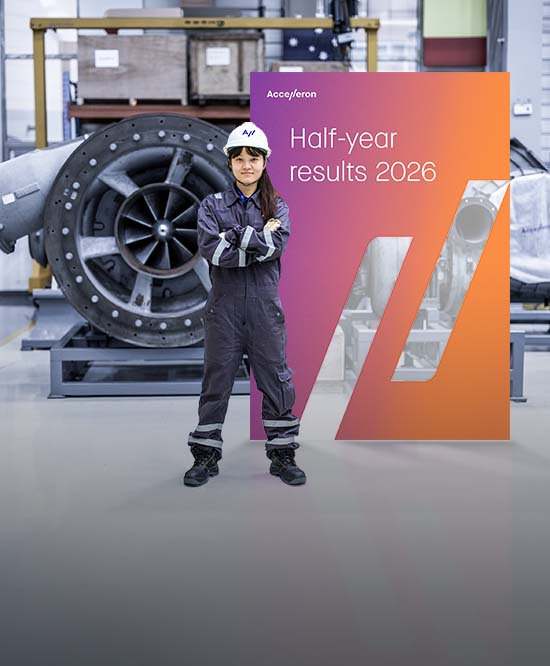
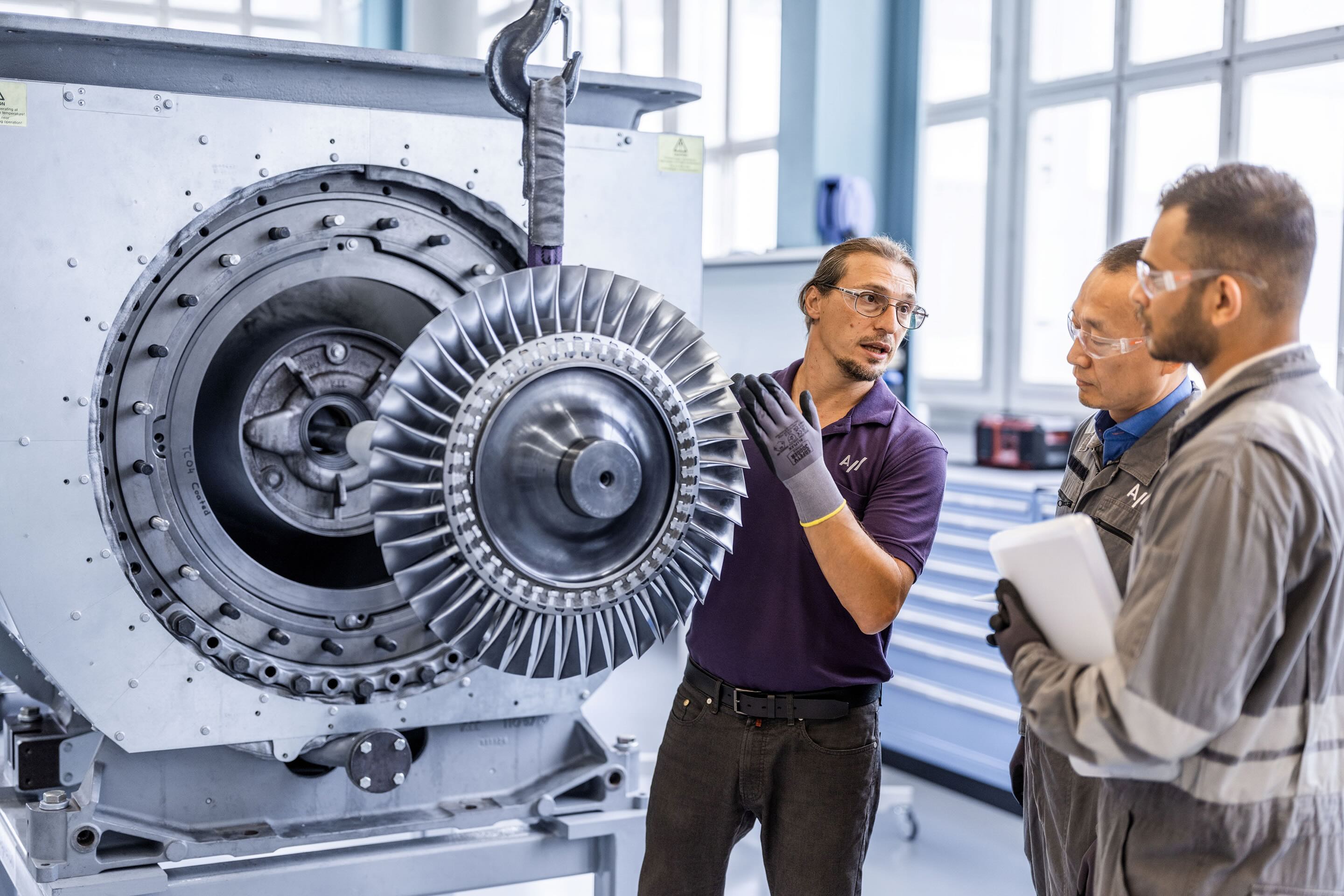
Accelleron’s service training program begins in Baden, from where all authorized service engineers are trained. Located in the same facility where Accelleron products are designed and made, the Baden service training center has become a crucial connection between product development and real-world use of those products. Service engineers that return to Baden for training not only take crucial, current knowledge back to their global locations; they also feed back to headquarters from discussions with operators in the field, allowing Accelleron to continuously hone its product offer based on deep in-service insights.
Accelleron service engineers are not simply onboarded once and dispatched. They cycle back through Baden, or through Accelleron’s practical training facilities in Shanghai, Singapore and Miami, roughly every three years for refresher work. “We train round about 350 service engineers a year,” Aberle says. “It’s not just an online refresher or e-learning. They come to us, we exchange knowledge, and we make sure the quality of our service stays the same.”
If the novelty of some decarbonization technologies is one challenge for service engineers, the longevity of Accelleron’s installed base is another. The company’s turbochargers run up to 8,000 hours a year and remain in operation for 30 years or more. “We have products in the field that are older than me, and they are still in operation,” notes Aberle.
Layered on top of that is acquired and partnered technology. A recently initiated partnership with Swedish company Somas brought control valves used in selective catalytic reduction (SCR) and exhaust gas recirculation (EGR) systems into service scope; the acquisition of OMT in 2023 added marine fuel injectors central to dual-fuel methanol and ammonia engines.
For a single field engineer, the breadth of knowledge that needs to be maintained is a considerable challenge. “If you train an engineer today and the next job is beginning of next year, how do you ensure the know-how is still present?” Aberle asks.
The answer is a combination of strong product documentation delivered through a mobile app, on-demand video learning, and weekly technical exchanges with partners. It also takes time: reaching the level where an engineer can independently handle the full product range, Aberle says, “can easily take five years.”
Safety is the biggest issue
Where decarbonization reshapes the curriculum most directly is in safety, not mechanics. Liquefied natural gas (LNG), when it arrived in volume as a marine fuel 15 to 20 years ago, was accompanied by widespread fears over leakage and explosion potential. Ultimately, the robustness of the technologies involved meant it “had almost no change” for turbocharger servicing, Aberle says. Based on early experience, methanol will similarly be accompanied with very few additional measures. Ammonia is the exception.
“The hardware itself remains exactly the same,” he says. “The procedure to take it apart and reassemble it is also similar. What’s new is understanding the safety impact coming from the fuel. What are the new safety regulations before you enter an engine room? How do you ensure there is sufficient ventilation and how do you ensure there is no leftover fuel in double-wall piping?”
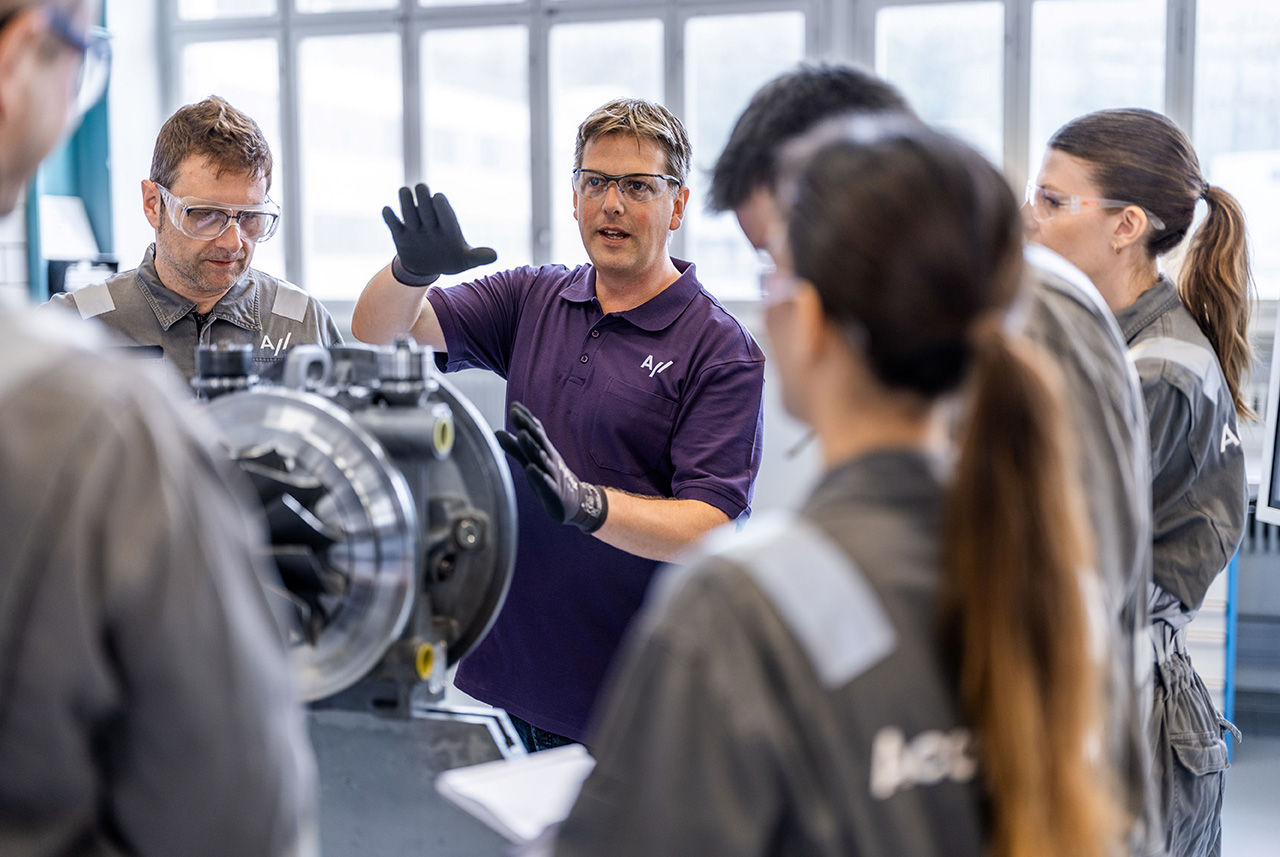
Accelleron’s response has been a dedicated e-learning module on alternative fuels, accessible across the globally distributed engineer base. Pre-job safety dialogue with vessel operators has also been embedded into the service workflow. Before boarding an ammonia-prepared vessel, engineers confirm detection systems are installed, that ventilation and double-walled piping have been managed, and that cleaning residues will not become airborne in occupied spaces.
“We need to create awareness that this is a special vessel,” Aberle says. “In the beginning now, as we have a handful of installations sailing around, it’s more the exception than the rule.”
When it comes to wider sustainability efforts, a best-practice sharing platform across the 100-station network is driving incremental wins. Recent emissions and waste reducing initiatives have included the introduction of dry-ice cleaning, a shift from open high-pressure washing to captured wastewater, and even evaluation of laser cleaning.
A growing skills gap
Martin is candid about another emerging dynamic. As ship operators reduce crew sizes and lengthen maintenance intervals, more service work has shifted permanently to specialist providers. That is appropriate for the most demanding tasks. But it also means seafarers themselves see turbocharger maintenance less often, compounding the on-board skills problem the industry now worries about publicly.
Accelleron’s investment in service training aims to support ship operators in bridging that gap. The exposure to cutting-edge technologies that Accelleron offers engineering recruits is also one way of bringing more talent to a role that – even on-shore – can struggle to attract new blood. A key role in industrial decarbonization is another attractive proposition, alongside a global career and progression routes into regional technical management, service coordination and product development roles back in Baden.
None of this will, on its own, close the maritime skills gap that DNV and the ICS have been warning about. But it is a concrete picture of what a credible response looks like inside one of the supply chain’s most critical service networks. The ships and engines, as Accelleron has often noted, are ready. The harder question – whether the people who run and maintain them will be – is one the company has already begun to answer.
Top 5 Questions
Why is the big picture (public/industry-wide) problem a challenge and for whom?
Maritime decarbonization is widely framed as a fuels and technology problem, but classification societies and the International Chamber of Shipping have warned that hundreds of thousands of seafarers will need additional training over the next decade to not only safely handle ammonia, methanol and other low- and zero-carbon fuels but as well as to handle the expected rise in technical complexity of systems running on new fuels. Less discussed is the parallel challenge onshore: the service engineers who maintain modern marine engines and turbochargers also have to upskill quickly, often without the daily, hands-on exposure that ships’ crews will accumulate. The challenge therefore lands on shipowners, shipbuilders, engine designers, and the service organizations they rely on.
How is the big picture (public/industry-wide) problem solvable, and by whom, with what?
The skills gap is solvable through sustained, structured investment by original equipment manufacturers, service providers, classification societies and operators – together. Practically, this means standardized training programs with central training hubs and regional practical centers, refresher cycles, robust digital learning, partner collaboration on new technologies (such as fuel injectors and emissions-control valves) and embedded safety procedures that travel with the engineer to each job. Without this combined effort, the installed fleet cannot be operated, maintained and ultimately decarbonized at the pace policymakers and operators require.
What is the positive, measurable impact when the challenge is solved, with timeframe, cost (savings), or emissions reductions, or other benefits?
A well-trained service workforce keeps the installed fleet running at high performance across a 30-year-plus lifecycle, which is the single largest efficiency lever available to shipping today – especially while supply of carbon-neutral fuels remains constrained. Accelleron alone serves more than 5,000 end customers each year through over 600 trained engineers operating at more than 100 service locations across more than 50 countries, with 350 engineers cycled through formal training annually. That scale of coverage translates directly into higher fuel efficiency, fewer unplanned outages, and emissions reductions that begin paying back immediately rather than in the 2030s.
How does this proposed solution compare to other solutions that don’t have as much impact or the same timeframes/costs/impact?
Other proposed responses to maritime decarbonization – new fuels, new propulsion technologies and new ship designs – depend on infrastructure, regulation and capital cycles that take a decade or more to deliver at scale. Accelleron’s 2025 Deadlock report notes that shipping emissions in 2024 hit an all-time high precisely when they were supposed to begin declining. Investing now in service skills, in contrast, leverages assets that are already on the water, improves efficiency immediately, and prepares the workforce so that when alternative fuels do arrive at scale, the people qualified to operate and maintain them are already there. It is the lowest-regret, fastest-acting complement to the longer-cycle fuel and engine transition.
How does Accelleron technology, service offering, thought leadership, or partnership help solve this challenge?
Accelleron operates one of the maritime sector’s largest service training programs, with all authorized service engineers trained from its Baden headquarters – the same site where Accelleron products are designed and manufactured. Engineers cycle back through Baden or through practical training centers in Shanghai, Singapore and Miami roughly every three years for refresher work. A dedicated e-learning module on alternative fuels is accessible across the globally distributed engineer base, and pre-job safety dialogue with vessel operators has been embedded into the service workflow. Partnerships and acquisitions (Somas control valves, OMT marine fuel injectors) are expanding service scope to cover SCR and EGR systems as well as dual-fuel methanol and ammonia engines. In addition, Accelleron offers several upgrade solutions such as Engine Part Load Optimization (EPLO) and the Flexible integrated Turbocharging System for 2-Stroke engines (FiTS2) that can help customers in improving fuel efficiency and emissions at low loads.
1. DNV, Maritime Forecast to 2050, 2024 edition, pp. 18 and International Chamber of Shipping (ICS), Catalysing the Fourth Propulsion Revolution, 2024, pp.19
2. Accelleron Industries, Deadlock: What’s stopping shipping’s carbon-neutral fuel transition? 2025, pp.2