









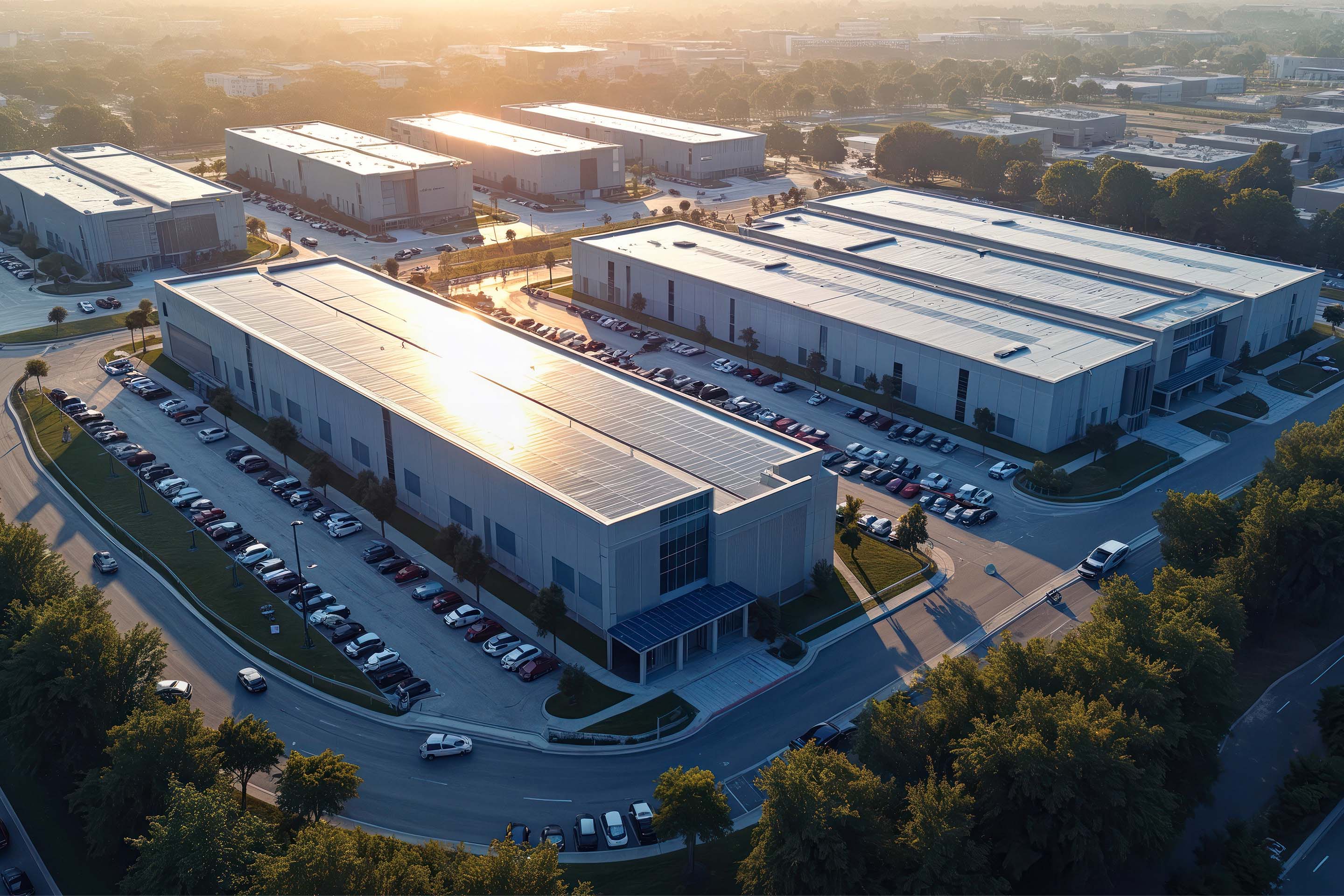


All that data that flows back and forth between phones, computers, infrastructure, planes, trains, and automobiles has its source in vast server farms, the physical manifestations of “the cloud.”
Such is the demand for AI-assisted services that these large warehouses, stuffed full of computer hardware, are set to propagate exponentially, each one becoming more immense in the coming years. Mark Zuckerberg, CEO of Meta, set a giant server farm to power Meta AI, which is already used by more people than any other AI assistant. This is driving Meta to build “a 2GW and potentially bigger AI data center that is so big, that it’ll cover a significant part of Manhattan if it were placed there.”
Meanwhile, Amazon has bought a 960MW nuclear-powered data center from Talen Energy Corp in March 2024, to support its web services. The center is located directly adjacent to Talen’s power station in Pennsylvania. A further agreement, announced in June 2025, commits Talen to provide increasing amounts of energy to the data center, rising to 1,920MW by 2032. The deal will run until 2042, with options to extend it further.
When those investments were reported, it is significant that the data centers’ capacities were not described in terms of the amount of data they will process or the speed at which they will deliver results, but by the electrical power they will consume, which will be massive.
But where will all this energy come from? It is clear that much more electrical power will be needed. Consultant McKinsey & Co views this as an investment opportunity. In a report published in April 2025, they projected that global data center capacity demand, including both AI and non-AI workloads, could grow from 82 GW in 2025 to approximately 219 GW by 2030, with fully 156 GW attributable to AI. The corresponding investment required for power generation and electricity infrastructure alone is estimated in the hundreds of billions to low trillions.
The G7 Summit in Canada in June 2025 issued a “Statement on AI for prosperity,” noting that “increased AI adoption will place growing pressure on our energy grids … and have implications for energy security, resilience and affordability.” However, it added that AI could also, “be harnessed to promote energy innovation and bolster the resilience and reliability of our energy systems.”
Energy deficiency
Where will these data centers get the power they need, and how can it be provided reliably? Although Amazon is experimenting with nuclear, currently, most data centers are connected to the local electricity grid, with back-up power generated by diesel engines that will automatically start if the power supply fails.
In this scenario, turbocharging has become a critical part of the infrastructure that supports the global growth of data centers, giving Accelleron customers a vital role in guaranteeing that power.
In a previous Charge! article, Accelleron explained how critical it is for data centers to provide continuous service, saying that they usually remain operational 99.999% of the time. The remaining 0.001% represents less than a second per day and any offline time in excess of that will trigger compensation payments.
In the meantime, power demands now often outstrip local grid availability, giving engine-powered generating systems increased significance, now not only as back-up systems, but increasingly as base load power.
Accelleron service representatives across 50 countries and over 100 locations have monitored power generation developments in their regions, with a particular focus on Accelleron’s largest power generation markets in Europe and North America.
This has revealed some important trends: investments in electricity grids and power generations are not able to keep pace with the growth of energy-hungry data centers, creating “a step-change” in power demand, and changing the balance between base load and back-up power supplies.
For example, in Ireland, where data centers were consuming about one fifth of the country’s entire electrical output, the government decreed that new data centers must provide their own on-site or adjacent power to match demand.
Underlining this new data center power landscape are four levels of power, as shown in the table.
Four levels of power | |
Base load (constant level of continuous power) | >6,000 hrs/yr |
Prime power (fluctuating levels of power, running continuously) | 2,000-4,000 hrs/yr |
Peak load (topping off power to meet temporary spikes in demand) | <1,000 hrs/yr |
Back-up | <100 hrs/yr |
Biggest growth sector
So great is the imbalance between power supply and demand that data center applications are a major business driver for Accelleron’s medium-speed turbocharger business and the fastest growing sector for high-speed business.
Indeed, data is a sector like no other. It requires fast start-up and the ability to cope with rapid load changes, in order to ensure that power comes online quickly while minimizing the battery capacity required to smooth out load variations. Both high-speed and medium-speed turbocharged engines are well suited to these demands, as they can activate quickly and are robust enough to provide reliable and resilient power.
The data center boom has led to a proliferation of turbocharged gas-fueled engines utilizing the A136-H, A240-H, and Power2 341 (two stage) turbochargers for primary power. Accelleron’s greatest challenge in the past months has been to ramp up production to meet demand, including requests for hundreds of turbochargers on short delivery schedules.
Many data center operators are also seeking to incorporate renewable energy as quickly as possible, entering power-purchasing arrangements for renewable energy, backed up by on-site generation to cover periods when green energy is not available. Reliable back-up power is critical for data center and critical infrastructure resilience. Thus fast-acting diesel-fueled engines are currently the main source of back-up power for data centers, for which Accelleron’s TPX family was specifically designed. As data centers seek to become more sustainable, eventually these engines can also burn low carbon and carbon-neutral fuels, such as hydrotreated vegetable oil (HVO), which has similar properties to diesel but is more expensive.
Ensuring a resilient, data-based world
With AI becoming an integral part of daily life around the world, the International Energy Agency predicts that global power demand for data centers will double to around 945 TWh by 2030.
“We are witnessing the fastest growth in power demand in history,” says Accelleron’s President of High-Speed Herbert Müller, “It is not merely the data itself, but our dependence on that data for communications and critical services, which demands a robust approach to the power structure. We are working with our customers – both engine designers and data center operators – to support both growth and resilience.”